
Damp and mould in rented homes have moved from being a maintenance issue to a legal one. Following a series of high-profile cases, the rules covering how quickly landlords must investigate and act have been tightened considerably.
For landlords, that means clearer duties and firmer deadlines. For tenants, it means a stronger position when reporting a problem. In this guide, Home Energy Save GB sets out what the law currently requires, what is changing and what both sides can do when damp appears.
Why the Law on Damp and Mould Changed
The current framework follows the death of two-year-old Awaab Ishak in Rochdale, which was linked to prolonged exposure to mould in his family’s home.
The case drew national attention to how damp and mould reports in rented housing were being handled, and in particular to how long they were being left unresolved.
The resulting legislation, widely known as Awaab’s Law, introduced fixed timescales for responding to hazards rather than leaving the pace of repairs open-ended.
The principle behind it is straightforward. Where a home contains a hazard that could affect health, the landlord must investigate promptly and act within a defined period.
What Awaab’s Law Requires
Awaab’s Law has applied to the social rented sector since October 2025. Its first phase covers damp and mould, along with emergency hazards.
The timescales are the central feature:
- Emergency hazards must be investigated and made safe within 24 hours
- Significant hazards, including damp and mould, must be investigated within 10 working days
- Findings must be communicated to the tenant in writing
- Work required to make the property safe must begin within set periods after the investigation
- Where a home cannot be made safe in time, suitable alternative accommodation may need to be offered
The clock starts when the landlord becomes aware of the potential hazard, not when they decide to act on it.
What Changes on 30 November 2026
A second phase of Awaab’s Law is scheduled to take effect on 30 November 2026, widening the range of hazards covered by the same timescales.
The additional categories include:
- Excess cold
- Excess heat
- Falls hazards
- Structural collapse and explosions
- Fire and electrical hazards
- Hygiene and food safety hazards
Excess cold is particularly relevant to damp. Cold internal surfaces are where condensation forms, and condensation is the most common route to mould growth in occupied homes.
In practice, a property with poor insulation and inadequate ventilation may now present two related hazards rather than one.
Does Awaab’s Law Apply to Private Landlords?
Not yet.
Awaab’s Law currently applies to the social rented sector. The Government has committed to extending it to the private rented sector and has said it will consult on how to do so, but no date has been confirmed at the time of writing.
Private landlords should treat this as a direction of travel rather than a distant possibility. The expectation that damp and mould reports are investigated promptly is already reflected in how local authorities and the courts approach disrepair.
Private landlords also remain subject to existing obligations, which have not gone away.
The Duties Private Landlords Already Have
Several long-standing requirements apply regardless of Awaab’s Law.
| Obligation | What it covers |
| Section 11, Landlord and Tenant Act 1985 | Keeping the structure and exterior in repair, including walls, roofs, gutters and drains |
| Homes (Fitness for Human Habitation) Act 2018 | Requiring a property to be fit to live in throughout the tenancy, with damp and mould expressly relevant |
| Housing Health and Safety Rating System | The framework councils use to assess hazards, under which damp and mould growth is a recognised category |
| Renters’ Rights Act 2025 | Reformed tenancies from 1 May 2026, including the end of Section 21 notices |
The change brought by the Renters’ Rights Act matters here. With Section 21 no longer available, a tenant reporting damp cannot simply be given notice, and the underlying issue has to be dealt with.
The Decent Homes Standard and Energy Efficiency
Two further changes are on the horizon for rented property.
The two changes are:
- A reformed Decent Homes Standard proposed to apply to the private rented sector, with Government indicating a date in the mid-2030s
- A rise in the minimum energy efficiency standard for private rented homes in England and Wales to EPC C by 2030
Both connect to damp. A property cannot usually be brought up to a higher energy rating while its walls are wet, because moisture in masonry increases heat loss and undermines insulation.
Landlords planning improvement work generally find it more effective to resolve moisture problems before insulating rather than afterwards.
What Landlords Should Do When Damp Is Reported
Responding well is largely a matter of process.
A reasonable approach includes:
- Recording the date the report was received
- Arranging an inspection promptly rather than waiting for the next visit
- Establishing the cause rather than assuming it is tenant behaviour
- Writing to the tenant with what was found and what will happen next
- Keeping a record of the works carried out and when
- Checking the property afterwards to confirm the problem has not returned
Advising a tenant to open windows more often is no longer an adequate response on its own. Where a building defect is allowing water in, or where the property has no effective ventilation, the cause is structural rather than behavioural.
An independent assessment can be useful in establishing which it is. Our guide on whose responsibility it is to resolve damp issues looks at how that line is drawn in practice.
What Tenants Can Do
Tenants reporting damp are in a stronger position when the report is clear and documented.
Helpful steps include:
- Reporting the problem in writing, by email or through a portal, rather than verbally
- Taking dated photographs of affected areas
- Noting where and when the problem appears, including whether it worsens after rain
- Keeping copies of all correspondence
- Contacting the local authority’s private sector housing team if there is no response
Rent should continue to be paid while a repair issue is unresolved, as withholding it can create separate difficulties. Advice on the right route is available from the local council or a housing advice service.
Further background is set out in our article on whether mould is a landlord’s responsibility.
Why the Health Evidence Matters
Part of the reason the law tightened is the growing body of UK research linking damp housing to respiratory illness, particularly in children.
Studies published in recent years have associated mould exposure in childhood with wheeze, allergic conditions and reduced lung function later on. That evidence is one of the reasons damp and mould were placed in the first phase of Awaab’s Law rather than a later one.
The practical implication for landlords is that damp is now treated as a health matter, not a cosmetic one. Our guide on what health issues mould can cause covers this in more detail.
How an Independent Damp Assessment Helps
Most disputes over damp in rented homes come down to a single question: what is causing it?
An independent assessment answers that question with evidence rather than opinion.
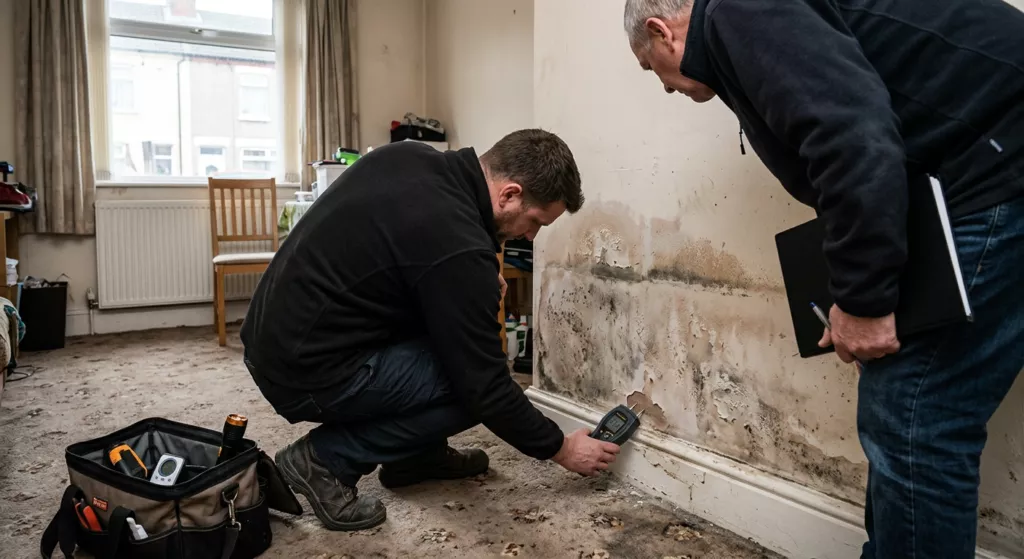
A Home Energy Save GB surveyor examines:
- Internal symptoms and where they appear across the property
- External defects that may be allowing water in
- Moisture readings across the affected areas
- External ground levels relative to the damp proof course
- Ventilation provision and how the property is being used
- Construction type and the age of the building
For a landlord, that establishes what work is genuinely required and demonstrates that the complaint was taken seriously. For a tenant, it provides a clear account of what is wrong.
Where treatment is needed, our damp proofing and mould treatment services address the cause rather than the surface.
Our complete guide to resolving damp issues explains how each type of damp is treated, which can help both landlords and tenants understand what a proposed schedule of works is actually for.
Final Thoughts on Damp and Mould in Rented Homes
The direction of the law is clear. Damp and mould reports now carry defined timescales in social housing, the range of hazards covered widens on 30 November 2026, and extension to the private rented sector has been committed to even though no date has been set.
For landlords, the practical response is to investigate promptly, identify the actual cause and keep a record of what was done. For tenants, it is to report in writing and keep evidence.
If damp or mould has been reported in a property you own or rent, Home Energy Save GB can establish what is causing it. You can book a free damp survey and a surveyor will attend, explain the cause and provide a quote for the work needed to resolve it.
This article provides general information about damp and mould in rented housing and is not legal advice. Anyone dealing with a specific dispute should seek advice from their local authority or a qualified housing adviser.
Frequently Asked Questions
Is damp and mould the landlord’s responsibility?
In most cases where damp is caused by a building defect, yes. Landlords are required to keep the structure and exterior in repair and to ensure the property is fit to live in. Where mould results from a defect such as a failed damp proof course, water ingress or inadequate ventilation, resolving it is the landlord’s responsibility.
How long does a landlord have to fix damp and mould?
Under Awaab’s Law, which applies to social housing, a significant hazard such as damp and mould must be investigated within 10 working days, and an emergency hazard must be investigated and made safe within 24 hours. Findings must be given to the tenant in writing and remedial work must begin within set periods.
Does Awaab’s Law apply to private landlords?
Not at present. Awaab’s Law currently applies to the social rented sector. The Government has committed to extending it to the private rented sector and has said it will consult on how this will work, but no date has been confirmed. Private landlords remain subject to existing repair and fitness obligations in the meantime.
What changes under Awaab’s Law on 30 November 2026?
A second phase widens the hazards covered by the same timescales to include excess cold, excess heat, falls, structural collapse, explosions, fire and electrical hazards, and hygiene and food safety hazards. Excess cold is closely linked to damp, because cold surfaces are where condensation and mould tend to develop.
Can a landlord blame condensation on the tenant?
Household activity does produce moisture, but that alone does not remove the landlord’s obligations. Where a property lacks adequate ventilation, has cold bridging or has a defect allowing water in, the cause is a building issue. An independent damp assessment is usually the clearest way to establish which factors are involved.
