
Spray foam insulation was fitted in thousands of UK lofts as a quick way to reduce heat loss. Many homeowners are now discovering that the same material can cause problems with moisture, roof timbers and, in some cases, selling or remortgaging the property.
The issue is not that insulation is bad for a roof. It is that a roof space needs to breathe, and some spray foam applications prevent that from happening. In this guide, Home Energy Save GB explains how spray foam and damp are connected, what warning signs to look for and what removal typically involves.
What Spray Foam Insulation Is
Spray foam is a liquid insulation applied directly to the underside of a roof, where it expands and hardens against the tiles and rafters.
It was often sold as an alternative to traditional loft insulation, particularly where a roof was ageing or where a homeowner wanted a warmer loft space.
There are two broad types:
- Open cell foam, which is softer and more permeable to moisture
- Closed cell foam, which is denser, rigid and far less permeable
Closed cell foam is generally associated with the greatest risk, because it can effectively seal the underside of the roof.
Why a Roof Space Needs Ventilation
Every home produces moisture. Cooking, bathing, drying laundry and simply breathing release water vapour that rises through the property.
In a traditional cold roof, that vapour reaches the loft and is carried away by air moving through vents at the eaves and ridge. The timbers stay dry because the moisture never has a chance to settle.
Remove that airflow and the moisture has nowhere to go.
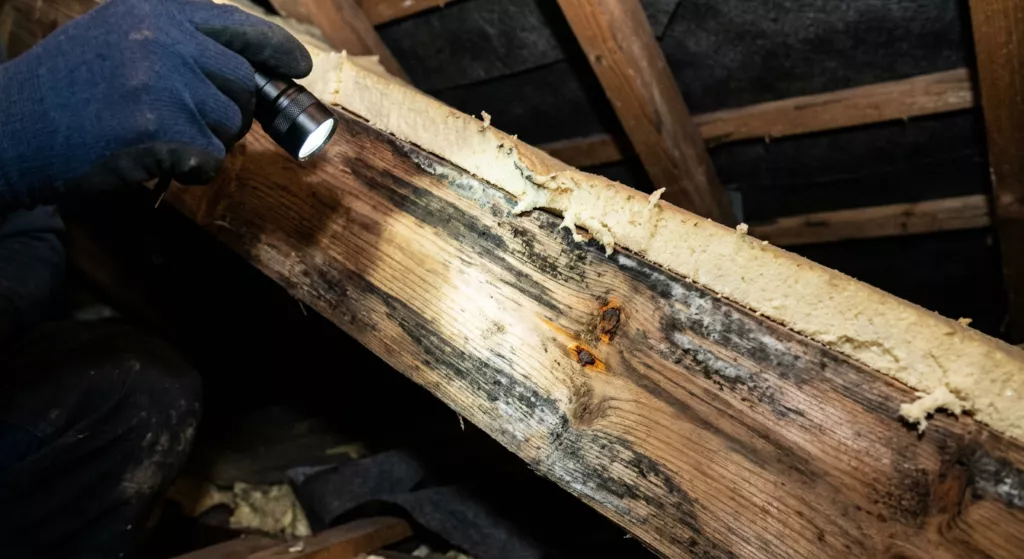
This is the core of the problem. Spray foam applied directly to the roof covering can block ventilation paths and trap water vapour against the very timbers that hold the roof up.
The result is a form of loft condensation, but one that is hidden from view rather than visible on the underside of the felt.
How Spray Foam Can Lead to Damp and Timber Decay
Where moisture becomes trapped, it condenses on cool surfaces inside the roof space and stays there.
Over time this can lead to:
- Persistently damp rafters and battens
- Wet rot developing in structural timber
- Corrosion of nails, fixings and metal plates
- Mould growth on timber and stored belongings
- Deterioration of the roofing felt beneath the foam
The difficulty is that the foam conceals the timber it is applied to. Decay can progress for years before anyone sees it, because the surface that would normally show the first signs is covered.
Independent inspections of foam-insulated properties have repeatedly found moisture-related defects behind the foam, including damp and decaying roof timbers.
Why Lenders and Surveyors Question Spray Foam
Many UK mortgage lenders now decline or restrict lending on properties with spray foam applied to the roof structure.
The concern is not usually the insulation itself. It is that a surveyor cannot inspect what lies beneath it. Where the condition of the roof structure cannot be verified, the property is harder to value with confidence.
This can affect homeowners in several situations:
- Selling the property to a buyer who needs a mortgage
- Remortgaging with a new lender
- Applying for equity release
- Arranging certain types of buildings insurance
Homeowners frequently discover the issue only when a sale is already under way, which is why it is worth understanding the position before reaching that stage.
Signs Spray Foam May Be Causing a Problem
Because the foam hides the roof structure, the early signs often appear elsewhere in the property.
Look for:
- A musty smell in the loft or on the upper landing
- Damp or staining on upstairs ceilings
- Mould on items stored in the loft
- Foam that has come away from the roof in places
- Visible dark staining on any timber still exposed
- Condensation forming on loft hatches or pipework
Any of these may indicate that moisture is being held in the roof space rather than escaping.
How Spray Foam Compares With Traditional Loft Insulation
Understanding the difference helps explain why one approach causes moisture problems and the other generally does not.
| Consideration | Traditional loft insulation | Spray foam on the roof slope |
| Where it sits | At ceiling level, between and over the joists | Against the underside of the roof covering |
| Roof ventilation | Maintained, provided eaves are kept clear | Frequently obstructed or sealed |
| Timber inspection | Rafters remain visible | Timbers concealed behind foam |
| Removal | Straightforward | Labour-intensive and usually specialist |
| Lender attitude | Generally unproblematic | Often queried or declined |
Insulation upgrades can also cause moisture problems when ventilation is overlooked, which we cover in our guide on why condensation happens after loft insulation.
What Spray Foam Removal Involves
Removal is a mechanical process. The foam is cut and scraped away from the rafters and roof covering, then the residue is cleaned back so the timber can be seen.
A typical sequence looks like this:
- Assessment of the foam type, coverage and roof construction
- Protection of the property and the loft access route
- Mechanical removal of the foam from timbers and roof covering
- Cleaning down of rafters so the timber condition can be assessed
- Inspection for rot, decay or insect activity
- Reinstatement of ventilation at eaves level
- Installation of appropriate replacement insulation
Costs vary with the size of the roof, the type of foam and how firmly it has bonded. Closed cell foam generally takes longer to remove than open cell.
You can read more about the process on our loft spray removal page.
Why Timber Should Be Checked After Removal
Removing the foam solves the ventilation problem. It does not repair damage that has already occurred.
Once the timbers are exposed, they should be assessed for moisture content and any sign of decay. Where wet rot has developed, affected sections may need treating or replacing before new insulation is fitted.
Prevention from that point onward depends on keeping moisture levels down, which we explain in our guide on how to stop timber rot occurring.
Where required, timber treatment can be carried out while the roof space is open and accessible.
What to Do If Your Loft Has Spray Foam
Having spray foam does not automatically mean there is damage. Some installations, particularly open cell foam applied where ventilation was retained, cause no problem at all.
What matters is establishing the facts before they become urgent.
Consider arranging an assessment if:
- You are planning to sell or remortgage
- You do not know which type of foam was used
- There is any musty smell or visible damp upstairs
- The installation is more than a few years old
- You have no paperwork from the original installer
Identifying the condition of the roof structure early gives you options. Discovering it mid-sale gives you very few.
Broader guidance on identifying moisture problems is available in our ultimate guide to diagnosing damp.
Final Thoughts on Spray Foam and Damp
Spray foam insulation is not a damp problem in itself. It becomes one when it blocks the ventilation a roof relies on and conceals the timbers underneath.
Where that happens, moisture can accumulate quietly for years before any sign appears inside the property. By the time it does, timber repair is often part of the work.
If your loft has spray foam and you are unsure whether it is causing a problem, Home Energy Save GB can assess the roof space and explain what condition the timbers are in. You can book a free damp survey and a surveyor will visit, explain what they find and provide a quote for any work needed.
Frequently Asked Questions
Does spray foam insulation always cause damp?
No. Problems arise where the foam blocks roof ventilation and traps moisture against the timbers, which is more common with closed cell foam applied directly to the roof slope. Some installations that retained adequate ventilation cause no issue. The only way to be certain is to have the roof space assessed.
Can I get a mortgage on a house with spray foam insulation?
Many UK lenders now decline or restrict lending where spray foam has been applied to the roof structure, largely because a surveyor cannot inspect the timbers beneath it. Lender positions vary, so it is worth checking with a broker. Removal followed by an inspection of the roof timbers often resolves the concern.
How is spray foam removed from a loft?
Removal is mechanical. The foam is cut and scraped from the rafters and roof covering, the timbers are cleaned back and inspected for decay, ventilation at the eaves is reinstated and suitable replacement insulation is fitted. Closed cell foam usually takes longer to remove than open cell.
What damage can spray foam do to roof timbers?
Trapped moisture can lead to persistently damp rafters, wet rot in structural timber, corrosion of fixings and mould growth. Because the foam conceals the timber, this can progress for years before it becomes visible from inside the property.
Should I remove spray foam before selling my house?
It is generally easier to deal with before a sale than during one. Establishing the type of foam, the condition of the timbers and whether removal is needed gives you time to plan. Discovering the issue after an offer has been accepted usually leaves far fewer options.
