
A damp survey in the UK typically costs somewhere between £150 and £400, depending on the size of the property and how far the investigation goes. Specialist investigations on larger or more complex buildings can cost considerably more.
Home Energy Save GB does not charge for one. In this guide we explain what damp surveys normally cost, what you get for the money, why ours is free, and what actually happens when a surveyor attends.
What a Damp Survey Actually Is
A damp survey is an inspection carried out to establish what is causing moisture in a building, rather than simply confirming that moisture is present.
That distinction matters. Rising damp, penetrating damp and condensation all produce similar staining, are routinely mistaken for each other, and need entirely different work.
A survey is where that question gets answered. Everything downstream depends on getting it right.
Our guide to diagnosing damp sets out how the three types are told apart.
What Damp Surveys Cost in the UK
Prices vary by property size, location and how deep the investigation goes. The ranges below are typical market figures for paid surveys, not our own pricing.
| Type of survey | Typical cost | What it is for |
| Independent damp survey, one or two bedroom flat | £150 – £250 | Establishing the cause of a known damp problem |
| Independent damp survey, three bedroom house | £200 – £325 | The most common paid survey |
| Independent damp survey, four bedroom detached | £250 – £400 | Larger property, more elevations to inspect |
| Large, listed or complex property | £350 – £500+ | Period construction, restricted access, multiple causes |
| RICS building survey covering damp | £400 – £800 | Damp assessed within a wider structural inspection |
| Specialist investigative survey | £1,000+ | Opening up, monitoring or laboratory analysis |
| Specialist contractor survey | Often free | Diagnosis and a quote for remedial work |
London and the South East sit at the upper end of each range. Fees are set by the individual surveyor, so ask what is included before booking.
What a Paid Damp Survey Usually Includes
Paying for a survey buys two things: an inspection, and something in writing at the end of it.
A paid survey commonly includes:
- A full internal and external inspection of the affected areas
- Moisture readings taken across walls, floors and any timber at risk
- An opinion on the cause, or on more than one contributing cause
- Written findings you can keep, show a solicitor or send to an insurer
- Recommendations for remedial work, without a quotation attached
- Independence from whoever might carry out the work
That last point is what most people are actually paying for. An independent surveyor has no financial interest in the outcome.
Why Our Survey Is Free
Home Energy Save GB is a specialist damp and mould contractor. The survey is how we understand a property well enough to quote for it accurately.
Charging for it would put a barrier in front of a conversation we need to have anyway, and quoting without seeing a property produces a number that changes the moment work starts.
So the survey is free because:
- We cannot price work responsibly without inspecting the building first
- An accurate diagnosis reduces the risk of returning to a job that was misdiagnosed
- Most people are trying to find out how serious a problem is before deciding anything
- A property we have inspected properly is one we can stand behind the quote on
It is a commercial decision rather than a charitable one, and it is worth being straightforward about that.
The Fair Question About Free Surveys
There is a criticism of free damp surveys that deserves an answer rather than a defence.
It is this: a contractor offering a free survey has an incentive to find a problem, because the survey is how they win the work. That is reasonable to be wary of, and there are firms in this trade that have earned the wariness.
What we would say is that the incentive cuts both ways. Recommending unnecessary work is expensive when a customer gets a second opinion, and misdiagnosing a problem is more expensive still, because we then return to a job that was never going to be fixed by what we specified.
The practical protection is the same whoever attends:
- Ask the surveyor to show you what they are seeing and explain why it points to one cause
- Ask what the alternative explanations are and why they have been ruled out
- Ask what happens if the recommended work does not resolve it
- Get a second opinion on anything substantial, particularly a full damp proof course
A surveyor who is confident in a diagnosis will have no difficulty with any of those questions.
What Happens When a Surveyor Attends
A typical visit takes between forty minutes and an hour and a half, depending on the property.
It normally covers:
- A conversation about what you have noticed, where, and how it changes with the weather
- An internal inspection of the affected rooms and the walls around them
- Moisture readings taken with a two-pin resistance meter pressed into the plaster, alongside a pinless search mode to sweep a wider area
- Checks on ventilation, extraction, surface temperatures and humidity
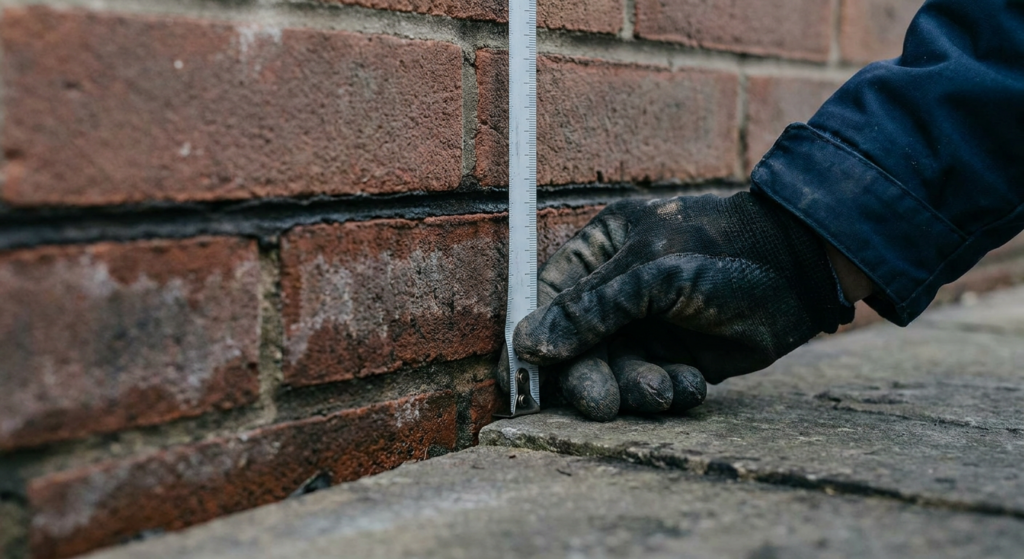
- An external inspection covering gutters, pointing, render, seals, flashing and ground levels relative to the damp proof course
- An explanation of what has been found, on site, while you are there
The surveyor talks you through the cause before leaving and answers whatever you want to ask. A written quotation for any recommended work follows afterwards.
You are not left with a document at the end of the visit. If that is what you need, the section below explains the right route.
What You Are Not Committing To
Booking a survey commits you to a visit and nothing else.
To be explicit:
- There is no charge, and no charge if you decide against the work
- There is no obligation to accept the quotation
- You are free to take the diagnosis and get the work done elsewhere
- You are free to get a second opinion, and it is sensible on larger jobs
- There is no follow-up pressure if you decide to do nothing for now
Some people book a survey purely to find out whether a problem is serious. That is a perfectly reasonable use of it.
When a Paid Independent Survey Is the Right Choice
A free contractor survey is not the right answer to every situation, and it would be dishonest to suggest otherwise.
Pay for an independent survey when:
- You are buying a property and need something to negotiate with or rely on
- You are making an insurance claim and the insurer needs documentation
- There is a dispute with a landlord, tenant, neighbour or previous contractor
- You need evidence for a legal case or a formal complaint
- You want an opinion from someone with no connection to the remedial work
In those cases the document is the product, and that is what the fee buys. Our article on damp surveys compared with building surveys covers which is appropriate when.
What No Survey Can Tell You on the Day
It is worth knowing the limits of any inspection, paid or free.
A visual survey cannot usually:
- See behind plaster, under floors or inside a cavity without opening up
- Confirm the extent of timber decay without exposing the timber
- Establish whether a defect is active where the weather has been dry for weeks
- Rule out a second contributing cause hidden behind the obvious one
Where a case is genuinely uncertain, the honest answer on the day is that further investigation is needed. A surveyor who is certain about everything, immediately, is worth a second opinion.
How to Prepare for the Visit
A small amount of preparation makes the visit considerably more useful.
Before the surveyor arrives:
- Move furniture away from the affected walls so they can be reached
- Clear access to the loft, any cellar and the external elevations
- Note when the problem was first seen and whether it changes with the weather
- Find dated photographs if you have them, particularly from wetter periods
- Gather any history of previous damp work, including guarantees
- Write down the questions you want answered before the surveyor leaves
Our guide on how to prepare for a damp survey goes through this in more detail, and the benefits of having a damp survey covers what a good one changes.
Final Thoughts on Damp Survey Costs
Most paid damp surveys in the UK fall between £150 and £400, and what you are buying is an independent opinion you can keep and rely on.
Ours is free because we are the ones who would do the work, and we cannot quote sensibly without looking first. Both models are legitimate and they suit different situations.
What matters more than the fee is whether the cause is correctly identified, because a misdiagnosed damp problem gets paid for twice.
Our guide to what damp proofing costs in the UK shows what is at stake once work starts.
If you would like to know what is causing damp in your property, you can book a free damp survey and a surveyor will attend, explain the cause and provide a quote for the work needed to resolve it. Where treatment is required, our damp proofing and mould treatment services address the cause rather than the surface.
Frequently Asked Questions
Is a damp survey really free?
Yes. There is no charge for the visit and no charge if you decide not to proceed with any work. Home Energy Save GB carries out the survey because it is the only way to quote accurately for remedial work, so the cost sits within the business rather than being passed on as a fee.
Will I be given anything in writing?
You are not left with a document at the end of the visit. The surveyor explains what they have found while they are with you, shows you the evidence and answers your questions, and you then receive a written quotation for any work recommended. If you need formal documentation for a property purchase, an insurance claim or a dispute, a paid independent survey is the right route.
How long does a damp survey take?
Most take between forty minutes and an hour and a half. A small flat with one affected wall is quicker, while a period property with several elevations, a cellar and a loft takes longer.
Do I have to use you for the work?
No. The diagnosis is yours to act on however you choose, including having the work carried out by someone else or doing nothing for the time being. Getting a second quotation on any substantial job is sensible and we would not discourage it.
What is the difference between a damp survey and a building survey?
A damp survey looks specifically at moisture and what is causing it. A building survey, such as a RICS Level 3, assesses the whole property and will flag damp as one of many findings without usually investigating it in depth. If damp is the known concern, a damp survey is the more focused option.
