
Awaab’s Law changed how quickly landlords have to act on damp, mould and other housing hazards. It replaced open-ended repair timescales with fixed deadlines that start the moment a landlord becomes aware of a problem.
It has applied to social housing in England since October 2025, and a second phase widens it considerably at the end of November 2026. In this guide, Home Energy Save GB sets out what the law requires, what the deadlines actually are, who it currently applies to and what both landlords and tenants should do.
What Awaab’s Law Is
Awaab’s Law is the name given to a set of duties placed on social landlords in England requiring them to investigate and act on housing hazards within defined periods.
It is not a standalone Act. The duties sit within the Social Housing (Regulation) Act 2023 and are given effect through regulations, and they are written into social housing tenancy agreements as an implied term.
The practical effect is straightforward.
Where a home contains a hazard that could affect the health or safety of the people living in it, the landlord has a set number of days to look at it, tell the resident what they found, and get the work moving.
Before this, the standard was that repairs be carried out within a “reasonable” period.
What counted as reasonable was argued case by case, and damp and mould reports could sit unresolved for months.
Why the Law Was Introduced
The law is named after Awaab Ishak, a two-year-old boy from Rochdale who died in December 2020. A coroner concluded that his death was caused by prolonged exposure to mould in the flat where his family lived.
The inquest heard that the mould had been reported repeatedly and had not been resolved, and that the family had been advised to treat it themselves.
What made the case a turning point was not that the hazard was unusual. It was that the response to it was so ordinary.
The legislation that followed was designed to remove the discretion that allowed that to happen, by attaching a clock to the report rather than to the landlord’s schedule.
The scale of the underlying issue is not small. Damp and mould are among the most frequently recorded hazards in rented housing, and the evidence linking them to respiratory illness has strengthened considerably. Our guide on what health issues mould can cause covers that evidence.
Who Awaab’s Law Applies To
At the time of writing, Awaab’s Law applies to social housing in England. That means local authority landlords, housing associations and other registered providers of social housing.
It does not currently apply to private landlords. It also does not extend to Scotland, Wales or Northern Ireland, which each have their own housing standards regimes.
The obligations fall on the landlord rather than on a managing agent or contractor. A landlord may delegate the work, but the deadline remains theirs.
Anyone unsure where responsibility sits in a particular arrangement may find our article on whose responsibility it is to resolve damp issues a useful starting point.
The Timescales at the Heart of the Law
The deadlines are the part that matters most in practice, and they are worth knowing precisely.
| Stage | Deadline | What has to happen |
| Emergency hazard | 24 hours | Investigate and make safe, or provide suitable alternative accommodation |
| Significant hazard — investigation | 10 working days | Investigate to establish whether a significant hazard is present |
| Written summary to the resident | 3 working days of the investigation concluding | Set out what was found and what will be done |
| Urgent safety work | 5 working days of the investigation | Complete any work needed to remove significant risk of harm |
| Longer-term remedial work | 12 weeks | Commence the works required to resolve the hazard properly |
Two details are commonly missed.
The first is when the clock starts.
It runs from the point the landlord becomes aware of the potential hazard, not from the point they decide to treat it as one. Awareness can come from a resident, a contractor, a gas engineer or a routine visit.
The second is that where the property cannot be made safe within the timescale, the landlord must offer suitable alternative accommodation until it can be.
What Changes in Phase 2 on 30 November 2026
Phase 1 covered damp and mould together with emergency hazards. Phase 2 keeps the same timescales and applies them to a much wider set of hazards.
Subject to parliamentary approval of the draft regulations, the following are added from 30 November 2026:
- Excess cold
- Excess heat
- Falls hazards, including falls on stairs, on the level and between levels
- Structural collapse and explosions
- Fire hazards and electrical hazards
- Domestic and personal hygiene hazards, and food safety
The Ministry of Housing, Communities and Local Government published its Phase 2 guidance for social landlords, along with an annex covering each hazard, on 13 July 2026.
Excess cold is the addition that matters most to damp. Cold internal surfaces are where condensation forms, and condensation is the most common route to mould growth in an occupied home.
That creates a practical overlap.
A property with poor insulation and inadequate ventilation may now present two linked hazards under the same set of deadlines, and treating one without the other tends to produce a second complaint a few months later.
Our guide to condensation control explains why ventilation and surface temperature have to be dealt with together.
How a Hazard Is Judged Significant
Awaab’s Law does not introduce a new definition of a hazard. It uses the existing framework, the Housing Health and Safety Rating System, usually shortened to HHSRS.
Under that system a hazard is assessed by the likelihood of harm occurring and the severity of the harm if it does.
A hazard is significant where it poses a significant risk of harm to the health or safety of the occupier.
Several factors influence that judgement:
- The extent of the damp or mould and how many rooms it affects
- Whether it is in a room used for sleeping or by a vulnerable occupant
- Whether the cause is active and ongoing or historic and dry
- How long the condition has persisted
- Whether any occupant has a relevant health condition
The presence of a young child, an older person or someone with a respiratory condition raises the assessment. It does not create a separate category, but it changes how the same physical condition is scored.
Does Awaab’s Law Apply to Private Landlords?
Not yet.
Awaab’s Law applies to the social rented sector. The Renters’ Rights Act 2025 contains a power allowing the Government to extend it to the private rented sector through secondary legislation, and the Government has committed to doing so.
The Government’s published roadmap for implementing the Renters’ Rights Act places that extension in a later phase of the programme, and has said it will consult on the detail, including the timescales that would apply.
No commencement date has been confirmed at the time of writing.
Some commentary in the property press has speculated about likely years. That remains speculation, and private landlords planning around a specific date are planning around something that does not yet exist.
What is reasonable to plan around is the direction. The expectation that damp and mould reports are investigated promptly and evidenced properly is already how local authorities and the courts approach disrepair, whether or not Awaab’s Law formally applies.
What Private Landlords Are Already Bound By
Several long-standing duties apply to private landlords now, regardless of Awaab’s Law.
- Section 11, Landlord and Tenant Act 1985 — keeping the structure and exterior in repair, including walls, roofs, gutters and drains
- Homes (Fitness for Human Habitation) Act 2018 — requiring the property to be fit to live in throughout the tenancy, with damp and mould expressly relevant
- The Housing Health and Safety Rating System — the framework councils use to assess hazards and issue improvement notices
- Renters’ Rights Act 2025 — reformed tenancies from 1 May 2026, including the end of Section 21 notices
The last of those changes the dynamic more than it first appears.
With Section 21 no longer available, a tenant who reports damp cannot simply be given notice, and the underlying issue has to be dealt with either way.
Our article on whether mould is a landlord’s responsibility looks at how these duties apply to mould specifically, and our overview of what the law says on damp and mould in rented homes covers the wider position for both sides.
What Landlords Should Have in Place Before 30 November
Meeting a deadline is mostly a matter of having a process rather than having more contractors.
A workable approach normally includes:
- A single point where hazard reports are logged with the date and time received
- A clear trigger that separates an emergency from a significant hazard on the day it arrives
- An inspection route that can be booked within the 10 working day window, not the next available slot
- A standard way of recording what was found, including photographs and moisture readings
- A template for writing to the resident within three working days of the investigation
- A route to alternative accommodation for cases where the property cannot be made safe in time
- A post-works check to confirm the hazard has not returned
The most common failure is not a missed repair. It is a report that was received but never formally recognised as a report, so the clock was never started.
Where Damp and Mould Cases Actually Go Wrong
In the cases that escalate, the pattern is consistent.
The frequent problems are:
- Treating the mould rather than the cause, so it returns within a season
- Recording “lifestyle” or “tenant behaviour” as the cause without establishing it
- Sending a general contractor rather than someone who can diagnose the type of damp
- Painting over affected plaster before the wall has dried
- Installing a fan without checking whether the underlying issue is water entering the structure
- Losing the paper trail between the report, the inspection and the works
Advising a resident to open windows more often is no longer an adequate response on its own. Where a building defect is letting water in, or where the property has no effective ventilation, the cause is structural rather than behavioural.
That distinction is the one that decides most disputes, and it is a technical question rather than a legal one. Our guide to diagnosing damp sets out how the three main types are told apart.
How an Independent Damp Assessment Fits the Timescales
The investigation stage is where the deadlines are usually won or lost, because everything after it depends on knowing what is actually wrong.
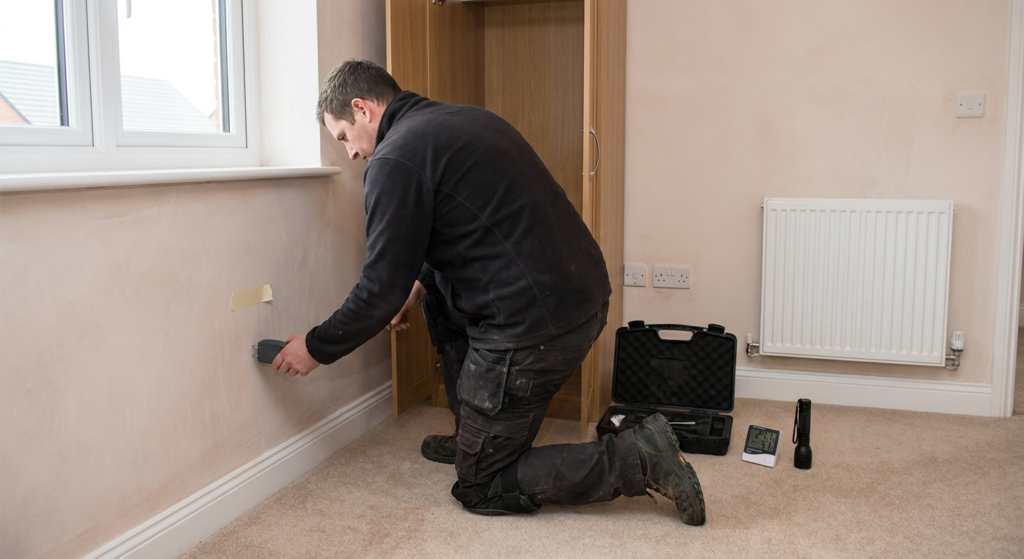
A Home Energy Save GB surveyor attends and examines:
- Internal symptoms and where they appear across the property
- Moisture readings taken across the affected areas
- External defects that may be allowing water in
- External ground levels relative to the damp proof course
- Ventilation provision and how the property is being used
- Construction type and the age of the building
The surveyor explains what they have found while they are on site, so the landlord knows the cause straight away and can write to their resident inside the three working day window with something accurate.
A quote for the recommended works follows.
For a landlord, that turns an open-ended problem into a defined scope. For a tenant, it means the cause is established by someone who inspects damp for a living rather than assumed.
Where treatment is needed, our damp proofing and mould treatment services address the cause rather than the surface.
What Tenants Can Do If a Deadline Is Missed
A tenant in social housing whose landlord has missed an Awaab’s Law timescale has several routes, and they work best in order.
The sequence that tends to work is:
- Report the hazard in writing, by email or through the landlord’s portal, and keep the date
- Take dated photographs each time the condition changes
- Raise a formal complaint through the landlord’s own complaints procedure
- Escalate to the Housing Ombudsman once the complaints process is exhausted
- Contact the local authority’s environmental health team, which can inspect under HHSRS
- Take advice on a disrepair claim, where the breach is an implied tenancy term
Rent should continue to be paid while a repair issue is unresolved, because withholding it can create separate and more serious difficulties. Advice on the right route is available from the local council or a housing advice service.
Final Thoughts on Awaab’s Law
The direction of travel is settled even where the dates are not.
Damp and mould reports in social housing now carry fixed deadlines, the range of hazards covered widens on 30 November 2026, and extension to the private rented sector has been committed to without a date being set.
For landlords, the practical response is the same in every case. Recognise the report, investigate it properly, establish the actual cause rather than assuming one, and keep a record of what was done and when.
Most of the risk in this area comes from misdiagnosis rather than from delay. A property where the cause has been correctly identified rarely generates a second report.
If damp or mould has been reported in a property you own or manage, Home Energy Save GB can establish what is causing it. You can book a free damp survey and a surveyor will attend, explain the cause and provide a quote for the work needed to resolve it.
This article provides general information about Awaab’s Law and is not legal advice. Anyone dealing with a specific case should seek advice from their local authority or a qualified housing adviser.
Frequently Asked Questions
What is Awaab’s Law?
Awaab’s Law is a set of duties on social landlords in England requiring them to investigate and act on housing hazards within fixed timescales. It is named after Awaab Ishak, a two-year-old who died in 2020 following prolonged exposure to mould in his family’s home. It replaced open-ended repair timescales with deadlines that start when the landlord becomes aware of the hazard.
How long does a landlord have to fix damp and mould under Awaab’s Law?
An emergency hazard must be investigated and made safe within 24 hours. A significant hazard such as damp and mould must be investigated within 10 working days, with a written summary given to the resident within three working days of the investigation concluding. Urgent safety work must be completed within five working days, and longer-term remedial work must commence within 12 weeks.
Does Awaab’s Law apply to private landlords?
Not at present. Awaab’s Law applies to social housing in England. The Renters’ Rights Act 2025 contains a power to extend it to the private rented sector through secondary legislation, and the Government has committed to consulting on how and when. No commencement date has been confirmed. Private landlords remain subject to existing repair and fitness obligations in the meantime.
What hazards does Awaab’s Law Phase 2 cover?
Subject to parliamentary approval, from 30 November 2026 the same timescales extend to excess cold, excess heat, falls hazards, structural collapse and explosions, fire and electrical hazards, and domestic and personal hygiene and food safety hazards. Excess cold is closely linked to damp, because cold surfaces are where condensation and mould tend to develop.
What happens if a landlord misses an Awaab’s Law deadline?
The duties are implied terms of the tenancy, so a missed deadline can be pursued as a breach of contract. A resident can complain through the landlord’s own procedure and then escalate to the Housing Ombudsman, and the local authority can inspect under the Housing Health and Safety Rating System and issue an improvement notice. The Regulator of Social Housing may also take an interest where failures are systemic.
