
The UK storm season opens on 1 September, and forecasters are expecting an unusually active one. The Met Office has described the El Niño event now developing in the Pacific as unprecedented.
For a building, that matters in one specific way.
Storms rarely create a damp problem from nothing — they find the places where a house was already going to let water in. In this guide, Home Energy Save GB explains what the forecast actually says, which parts of a property tend to fail first, and why a mild wet winter can be harder on a house than a cold one.
What the Met Office Has Forecast for 2026/27
The Met Office published its assessment of the developing El Niño on 21 August 2026. The scale of the event is what makes it notable.
Sea-surface temperatures in the Niño 3.4 region of the equatorial Pacific are forecast to run more than 3°C above normal. A typical El Niño produces a rise of between 1°C and 2°C.
Professor Adam Scaife, who leads long-range forecasting at the Met Office, put it plainly: “I have never seen an El Niño signal this intense in our forecasts.”
What that means for the UK is expressed as a shift in likelihood rather than a prediction. The Met Office expects the influence of El Niño to increase the chances of wetter, stormier conditions across north-western Europe, including the UK, through autumn and early winter.
That is an increased probability, not a guarantee. But if you own or manage property, the sensible response to a raised risk is to look at the building before the weather arrives rather than after it.
Why the Storm Season Starts in September
The UK storm-naming year runs from 1 September to 31 August, operated jointly by the Met Office, Met Éireann in Ireland and KNMI in the Netherlands.
A storm is given a name when it is expected to cause medium or high impact somewhere across the three countries. The list resets each September and works alphabetically.
Several things change in the weather pattern at roughly the same time:
- The jet stream strengthens as the temperature contrast across the Atlantic increases
- Low pressure systems begin tracking closer to the UK rather than passing to the north
- Rainfall totals rise while daylight hours and drying conditions fall away
- Wind and rain start arriving together rather than separately
That last point is the one that matters most for damp. Rain and wind in combination behave very differently to rain on its own.
How Driving Rain Turns Into Penetrating Damp
Rain falling vertically mostly runs down a wall and away. Rain driven horizontally by wind is pushed against the wall face and held there.
This is what surveyors mean by driving rain, and it is the main mechanism behind penetrating damp. West and south-west elevations take the worst of it, because that is where most UK weather arrives from.
A wall that copes perfectly well with ordinary rainfall may still let water through under sustained driving rain. Common weaknesses include:
- Eroded or missing mortar joints, particularly on older solid brick walls
- Hairline cracks in render that open up in wet weather
- Failed or bridged cavity wall insulation carrying moisture across the cavity
- Porous or spalled brickwork that has lost its outer face
- Unsealed junctions around windows, doors and pipe penetrations
Our guide to everything you need to know about penetrating damp covers how this type of damp is diagnosed and treated.
The Parts of a House That Fail First in a Storm
Storm-related damp usually starts at a handful of predictable points.
| Element | What tends to fail | What it lets in |
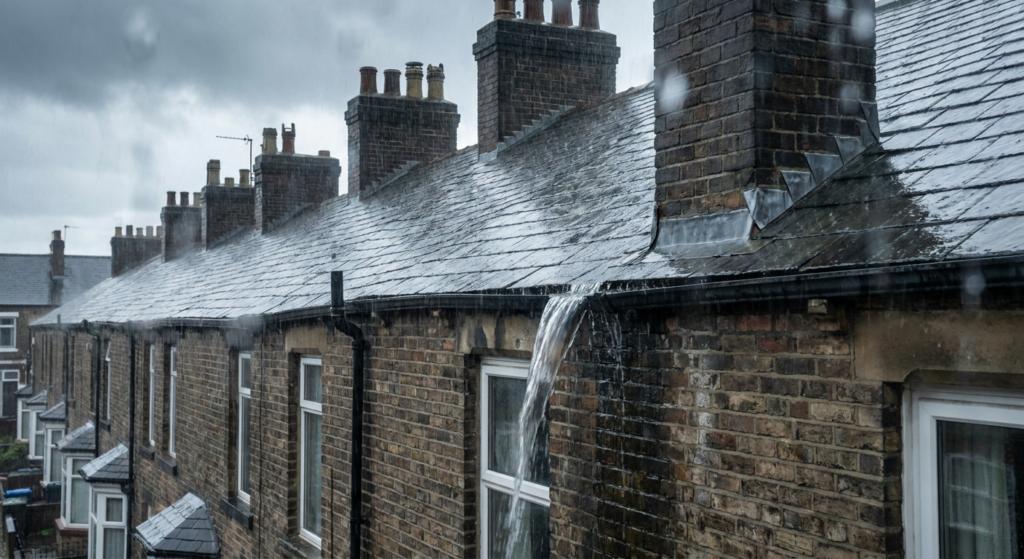
| Gutters and downpipes | Blockages, splits and loose joints overflowing under heavy rain | Concentrated water down one section of wall |
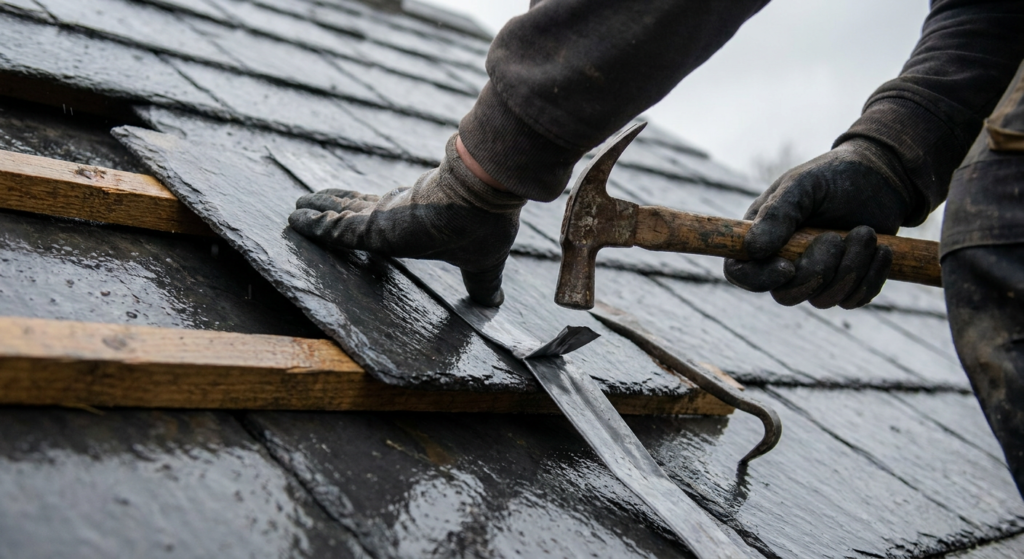
| Roof coverings | Slipped or cracked tiles and lifted ridge sections | Water into the loft, often unseen for weeks |
| Chimney and flashing | Perished lead flashing and open mortar joints in the stack | Damp on the chimney breast, sometimes on a different floor |
| Pointing and render | Erosion, cracking and blown sections | Water absorbed directly into the wall |
| Window and door seals | Perished mastic and failed frame junctions | Damp at the reveal and beneath the sill |
| Ground levels | Soil, paving or decking raised above the damp proof course | Moisture bridging past the damp proof course |
None of these are dramatic failures. They are small defects that only show themselves when the weather is severe enough to test them.
Why Wind Matters as Much as Rain
Wind does more than deliver the rain. It also changes the pressure across a building.
Air pressure on the windward face of a house rises during a storm while pressure inside stays roughly constant. Water sitting in a joint or a lap can be pushed inwards, and in some cases upwards, against gravity.
It is why a window that has never leaked in ten years can leak in a single gale, and why the damp patch often appears higher than the defect causing it.
Why a Mild, Wet Winter Is Worse for Mould Than a Cold One
A wet winter is not automatically a cold one, and the difference matters more than most people expect.
Mould needs moisture on a surface and a temperature it can grow in. Most household moulds do very little below about 5°C but grow steadily in the range that a mild British winter provides.
A cold winter tends to suppress growth for weeks at a time. A mild, wet one does not, because several things line up at once:
- Surfaces stay damp for longer, with little dry weather between spells
- Temperatures stay inside the range mould grows in rather than dropping below it
- Heating is used less, so there is less warmth available to dry those surfaces
- Windows stay shut, so there is less air movement to carry the moisture away
The result is a season that feels comparatively pleasant outdoors while being close to ideal for mould indoors.
Why Damp Often Appears Weeks After the Rain Stops
A common question after a storm is why the damp patch turned up so late.
Masonry holds water. A solid wall that has been repeatedly soaked can take a long time to give that moisture back up, and while it does, moisture continues to migrate through the structure towards the drier internal face.
Plaster then shows the result. Staining, blistering paint and salt deposits can appear well after the weather that caused them has passed.
This is why we look at exposure and orientation rather than only at the day it rained. Our article on why walls can be wet when it has not rained explains the mechanism in more detail.
What to Check After Every Named Storm
A short look after each storm is worth more than one long inspection in March.
From ground level, safely, look for:
- Water marks or staining running down an external wall below a gutter joint
- Slipped, cracked or missing tiles, and any daylight visible at the ridge
- Debris in gutters, and overflowing during the next downpour
- Fresh cracks in render, particularly around openings
- Loose or displaced flashing at the chimney and any abutment
- Pooling water at the base of walls where a gully has blocked
Cracks that open and close with the weather are worth recording. Our guide on whether cracks in walls are a sign of damp sets out which ones matter.
What Storm Damage Looks Like From Inside
Internal symptoms arrive later, and tend to be localised rather than general.
Signs worth acting on include:
- A damp patch with a defined edge, often darker after rain and lighter in dry spells
- Staining on a chimney breast or in a top-floor ceiling corner
- Blown or crumbling plaster at one point on an external wall
- A tide mark that reappears in the same place each time the weather turns
- A musty smell in a room that was previously fine
Damp that changes with the weather is usually penetrating damp. Damp that stays constant and appears on cold surfaces across several rooms is more likely to be condensation.
When to Have a Property Assessed
Some storm damage is obvious. Damp is often not, because the point where water enters and the point where it shows are rarely the same place.
Consider arranging a professional assessment if you notice:
- Damp that returns in the same spot after every spell of wet weather
- Staining on an upper floor or ceiling following a storm
- Blown plaster or salting on an external wall
- A damp patch that is spreading rather than drying
- Mould appearing in a room that has never had it before
Where the cause is water entering through the structure, our penetrating damp service deals with the defect rather than the stain it leaves behind. On a genuinely exposed elevation, rendering or a breathable masonry protection system may also be appropriate.
Final Thoughts on the 2026/27 Storm Season
The forecast raises the odds of a wet, stormy autumn and early winter. It does not guarantee one, and no forecast at this range can.
What it does justify is bringing maintenance forward. The defects that let storm water into a building are almost always small, visible and cheap to put right before the season starts.
Our companion guide on how to prepare your home for a wet winter works through the sequence.
If damp has already appeared after wet weather, Home Energy Save GB can establish where the water is getting in. You can book a free damp survey and a surveyor will attend, explain what is causing it and provide a quote for the work needed to resolve it.
Frequently Asked Questions
Can a single storm cause damp?
A single storm rarely creates a damp problem on its own, but it frequently exposes one. Driving rain and wind pressure test defects that ordinary rainfall never reaches, so a wall that has coped for years may let water through in one severe spell. The storm is the trigger rather than the cause.
How long after heavy rain does penetrating damp appear?
It varies with the construction and the severity of the weather. Water can show through within hours where there is a direct route in, but on solid masonry it commonly takes days or weeks, because the wall absorbs the water first and releases it slowly towards the internal face.
Does home insurance cover storm-related damp?
Policies usually cover sudden storm damage, such as a roof stripped by high winds, but exclude damage described as gradual deterioration or poor maintenance. Damp caused by blocked gutters or eroded pointing is often treated as a maintenance issue. Establishing the cause is usually the first step in any claim, and you should check your policy wording.
Is a mild wet winter really worse for mould than a cold one?
In many homes, yes. Mould growth slows considerably in cold conditions but continues through the temperature range a mild British winter provides. When surfaces stay damp and the property is heated less because it feels comparatively warm outside, conditions can favour mould for months rather than weeks.
