
Most of the damp that shows up in January is created in October. The defect is usually already there in September, dry, harmless and completely invisible until the rain starts finding it.
Autumn is the last comfortable window to deal with it. In this guide, Home Energy Save GB works through twelve checks worth making before the wet season sets in, what each one is actually looking for, and which ones are worth handing to someone else.
Why Autumn Is When Winter’s Damp Problems Are Made
A building stays dry by shedding water, resisting water and releasing moisture. Autumn puts pressure on all three at once.
Rainfall rises while drying conditions fall away. Leaves fill gutters at exactly the point gutters start being needed. Heating comes on, raising indoor humidity, while windows start staying shut.
None of that causes damp on its own. It removes the margin that was hiding a small defect for the rest of the year.
Where the Water Actually Comes From
Before checking anything, it helps to know which of the three routes you are looking for.
| Route | Typical cause | How it behaves |
| Water from outside | Roof, gutters, pointing, render, seals, flashing | Worsens after rain, localised, defined edge |
| Water from the ground | Failed or bridged damp proof course, high ground levels | Low on the wall, tide mark, salting, fairly constant |
| Water from inside | Condensation from cooking, washing, drying and breathing | Cold surfaces, corners, behind furniture, worse in cold spells |
The twelve checks below are grouped the same way, because a check only makes sense if you know what it protects against.
Checks 1 to 4: Getting Water Off the Building
1. Gutters and Downpipes
Blocked gutters are the single most common cause of avoidable penetrating damp, and the cheapest to prevent.
Look for:
- Compacted leaves, moss and silt, particularly at the outlet
- Plant growth in the gutter run, which indicates long-standing debris
- Staining or green algae on the wall below a joint
- Sagging sections where the fall has been lost
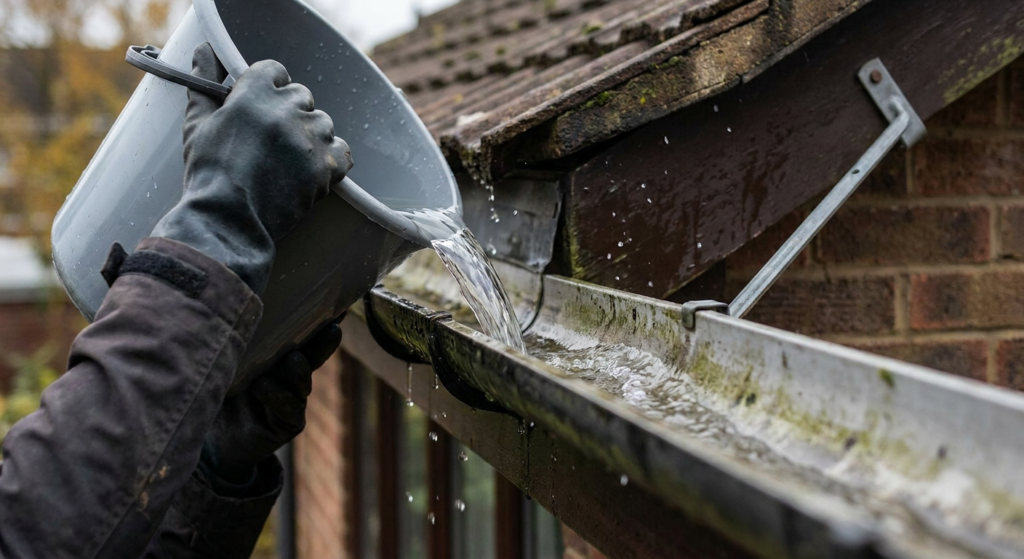
The reliable test is to watch the gutters during heavy rain. Anything overflowing, dripping at a joint or running down the wall needs attention.
2. Roof Tiles, Ridge and Verges
Check from ground level with binoculars rather than from a ladder. Roof work is not a homeowner job.
Look for slipped, cracked or missing tiles, gaps along the ridge, loose mortar at the verges and any sag in the roof line.
From inside, a daytime look into the loft with the light off will show pinholes of daylight where coverings have moved.
3. The Chimney and Its Flashing
Chimneys are exposed on every side and are a frequent source of damp that shows up on an internal chimney breast, sometimes a floor below.
Look for open mortar joints in the stack, a cracked or missing pot, damaged haunching at the top and lead flashing that has lifted or perished where the stack meets the roof. Our guide on chimney damp problems covers what each fault tends to produce.
4. Gullies, Drains and Downpipe Outlets
Water has to get away from the building as well as off it.
Clear leaves from gullies, check that downpipes discharge into the drain rather than beside it, and look for pooling at the base of walls after rain.
Checks 5 to 8: Keeping Water Out of the Walls
5. Pointing and Render
Mortar erodes faster than brick, and render cracks before it falls off.
Look for:
- Recessed or crumbling mortar joints, especially on the weather-facing elevation
- Cracks in render, particularly around window and door openings
- Hollow-sounding render, which indicates it has blown away from the wall
- Spalled brick faces where the outer surface has flaked away
Our article on whether cracks in walls are a sign of damp explains which cracks matter and which are cosmetic.
6. Window and Door Seals
Perished mastic around a frame is easy to miss and easy to fix.
Run a finger along the external seal and look for gaps, shrinkage or sections that have come away. Check that sills still throw water clear of the wall and that the drip groove underneath is not filled with paint.
7. External Ground Levels and the Damp Proof Course
The damp proof course should sit at least 150mm above the external ground level.
Raised borders, new paving, decking and gravel added over the years can bridge it and let moisture pass straight into the wall above. Where soil or paving now sits at or above the course, lowering it is usually the fix.
8. Boundary and Party Walls
Shared and boundary walls are nobody’s priority until they leak.
Check for missing coping stones on a garden wall abutting the house, saturated masonry where a neighbouring gutter discharges onto your elevation, and vegetation growing against a wall face.
Checks 9 to 12: Letting Moisture Out
9. Airbricks and Subfloor Vents
Suspended timber floors rely on air moving underneath them. Blocked ventilation leads to damp and, over time, to decay.
Look for:
- Airbricks covered by soil, render, paving or plant growth
- Vents blocked deliberately to reduce draughts
- Fewer airbricks than the run of wall would suggest
- A musty smell at floor level in a ground floor room
Airbricks should stay open through winter. They are not the reason a room feels cold.
10. Trickle Vents and Background Ventilation
Most modern windows have trickle vents along the top of the frame, and a great many of them are shut.
Open them and leave them open. They provide the slow background air change that keeps humidity down without the heat loss of an open window.
11. Extractor Fans
A fan that runs is not necessarily a fan that works.
Hold a sheet of tissue paper against the grille with the fan on. If it does not hold, the fan is not moving meaningful air. Check that bathroom and kitchen fans have an overrun timer, that ducting runs to an external terminal rather than into a loft, and that the external grille is clear.

12. The Loft
The loft shows problems earlier than any other part of the house.
Look for daylight through the roof covering, dark staining on rafters or felt, damp or compressed insulation, insulation blocking the ventilation gap at the eaves, and condensation on the underside of the felt on a cold morning.
What You Can Safely Do Yourself
Several of these checks are genuinely straightforward, and doing them costs nothing.
Reasonable to do yourself:
- Looking at the roof and chimney from ground level with binoculars
- Watching the gutters during heavy rain
- Clearing gullies and drain covers at ground level
- Opening trickle vents and testing extractor fans
- Checking airbricks and clearing soil or growth away from them
- Cutting back vegetation growing against a wall
Work at height is a different matter. Gutter clearing from a ladder is a common cause of serious injury, and roof or chimney work should not be attempted from a ladder at all.
The Jobs Worth Booking Before October
Some items are worth paying for now rather than dealing with in January.
Typically worth booking:
- A gutter clear and check, ideally with the run rodded and tested
- Refixing slipped tiles and any loose ridge sections
- Repointing eroded joints on the weather-facing elevation
- Repairing cracked or blown render before water gets behind it
- Renewing perished flashing at the chimney and abutments
- Lowering ground levels where they have bridged the damp proof course
These are small jobs in September and much larger ones by January. Our guide on how to prepare your home for a wet winter covers the sequence, and this year there is a stormier than usual season forecast to plan around.
What to Do If You Already Have Damp
If damp is already visible, the checklist becomes a diagnostic exercise. Useful things to record before anyone attends:
- Where the affected area is and how high up the wall it reaches
- Whether it worsens after rain or stays the same
- Whether it appears on external walls only or on internal ones too
- When it was first noticed and whether it has spread
- Dated photographs taken in both wet and dry weather
That often narrows the cause before a meter comes out. Our guide to the common reasons a home feels damp is a useful cross-check.
When a Check Turns Into a Survey
A checklist finds defects. It does not always identify which one is producing the damp you can see, because the entry point and the symptom are often in different places.
Consider arranging a professional assessment if you notice:
- Damp that returns in the same place every winter despite repairs
- A tide mark or salt deposits low down on a wall
- Blown or crumbling plaster on an external wall
- Mould returning within weeks of being cleaned off
- Damp that appears on an upper floor or ceiling
Our guide to diagnosing damp sets out how the three types are distinguished, and our damp proofing service deals with the cause rather than the surface.
Final Thoughts on the Autumn Damp Checklist
Very little on this list is expensive, and most of it takes an afternoon. The value is in doing it before the weather makes the point for you.
A house that sheds water properly, resists it where it lands and lets internal moisture out will handle a wet winter without complaint. One that fails at any of those three will find the weakest point on its own.
If a check has turned up something you would rather have looked at properly, Home Energy Save GB can establish what is causing it. You can book a free damp survey and a surveyor will attend, explain the cause and provide a quote for the work needed to resolve it.
Frequently Asked Questions
When should I check my house for damp before winter?
September is usually the best month. The weather is still settled enough to work outside, contractors are not yet stretched by storm callouts, and anything found can be repaired before sustained rain arrives.
Can I clear my own gutters?
Many people do, but falls from ladders are a common cause of serious injury and gutter clearing is one of the main reasons homeowners go up one. If the gutters are above single storey height, or the ground is soft or sloping, it is usually worth paying someone with the right access equipment.
Should airbricks be blocked in winter to keep the house warmer?
No. Airbricks ventilate the void beneath a suspended timber floor, and blocking them allows moisture to build up under the floor, which can lead to damp and eventually to timber decay. They should stay clear all year, and any that have been covered by soil, render or paving should be reopened.
Will an extractor fan on its own stop condensation?
Sometimes, but not always. A fan helps considerably where the moisture is being generated in that room and the fan is powerful enough, ducted correctly and actually used. Where surfaces are cold because of poor insulation or a cold bridge, or where water is entering the structure, ventilation alone may not be enough.
